Saturday, 4 May 2013

Mulch Ado About Nothing

It's Autumn & time to mulch. Personally I would like to see the garden get a bit moister before I place another layer on my gardens, but we make do with what Mother Nature gives us.
Mulching is a great time for the garden. I always like the look of everything when its been freshly mulched, all uniform & weed free (for a while at least). If you are going to mulch, it is always a good idea to dig in a 2 - 3 cm layer of compost first. 

What Is Mulch?
Mulch is the term used to describe the uppermost layer of soil. Every ecosystem has mulch in some form - ie in the bush, it is leaves & twigs that protect the soil (remember this when raking & burning those leaves). In the desert, it is sand or pebbles.

Why do We Mulch?
There are four important reasons to mulch. 
1/ The most important reason, in Australia, is water conservation.  Mulch stops the top of the soil drying out, keeps the soil moist, helps stop soil erosion and can reduce watering by about 60 per cent. 
2/ Mulching also prevents weeds and weed seed germination, which compete with plants for moisture and nutrients. 
3/ Mulching keeps the soil temperature constant & helps protect delicate root systems in times of frost as well as searing heat.
4/, Using an organic mulch means you’re adding extra organic matter to the soil & encouraging worm movement in the soil. 
Bark Mulch


Mulch types

Mulches can either be organic or inorganic, but I prefer organic mulches because they break down and add organic matter to the soil. This improves soil structure and drainage, and encourages earthworm and soil microbial activity.
 

Organic mulches, such as straw based mulches, are quite common. Try pea straw, but there is also lucerne and bean, and cane type mulches. They can either come by the bale or some people prefer to use the chopped product for a neater look. 

Cube type mulches are also available, such as cubed pea straw which has other ingredients added to it. As soon as this mulch gets wet it forms a softer material. This can be used as mulch, but is better used as a soil conditioner and worked through the soil. 

My favourite mulch is pea straw and I love to use it by the bale because it's easy to use and inexpensive. Simply grab a biscuit and lay it on the garden like pavers. Then loosen it up to fill the gaps.  The only problem with pea straw is the weeds that come with it.

Bark based mulches are another great organic choice. An advantage of the bark based mulches is they take longer to break down so you don't have to apply them as often. They come in a range of grades, from fine through medium, and coarse. It's best to use medium to coarse grade bark mulches because they don't absorb any moisture and allow rainfall, or irrigation water, to penetrate the soil where it's needed. Another problem is that during the natural decomposition of woody materials, such as uncomposted fresh sawdust, pine bark and woodchips, soluble nitrogen is taken from the mulch by fungi and bacteria. This causes something called nitrogen drawdown, but it can be overcome by applying a balanced organic fertiliser before mulching. 


Inorganic mulches, including scoria, gravel and stone river pebbles, don’t break down. These come in a range of colours, are trendy at the moment, and can look effective when used as mulch on pot plants. But bear in mind, if using pebbles in the garden, do it where they will not be littered by leaves and other debris, or it will end up looking messy. Plants with low nutrient requirements, such as many native plants, often benefit from inorganic mulches. Thick woody mulches without leaves are also perfect for these types of plants as they last longer before breaking down and they release very little nutrients.

Stone pebble Mulch

The depth of mulch depends on the type of mulch used. For coarse mulches a layer of between 2 and 6 centimetres is ideal. Although unprocessed straw mulches from the bale can be applied thicker. 

Very fine mulches are to be avoided as they can compact and not allow water to penetrate to the soil beneath. Their fineness also means they are capable of holding a lot of water, once again preventing it from infiltrating the soil beneath.

A good organic mulch is one that is a mix of fine and coarse particles.

Rather than using lawn clippings, leafy prunings and leaf litter as mulch, it's far better to put it in the compost and let it break down naturally. Although some people like to apply compost as mulch, it's actually better to use a coarser material, such as straw or bark. But try putting compost on first, and use it as a soil conditioner or improver, and then add mulch.                

How to Mulch
Take these few steps before laying your mulch down to ensure success.
  1. Remove or poison weeds (then wait for a fortnight after using poison)
  2. Moisten the soil thoroughly. Ensure that the water you apply is penetrating .
  3. If the water is running off the surface, fork through some compost to aid with the water retention.
  4. If you are planting into the soil, add some water saving crystals into the planting hole.
  5. If you are using bark-based mulches, you might consider sprinkling some blood and bone over the soil. This extra nitrogen will compensate for any nitrogen being taken up by the gradual decomposition of the mulch.
  6. Lay your mulch thickly (7-8cm deep), keeping the area directly around plants free of mulch.
  7. Lastly sprinkle soil wetting agents over the surface. This will ensure that any watering doesn’t run off the surface of the mulch.
Following these steps will mean you have mulched well.

How often?

Over time organic mulches break down, contributing beneficially to soil structure. Fine mulches will break down quicker than more coarse materials and so will need topping up more often. A yearly top up is usually enough.
The length of time that it takes for a mulch to break down determines how rapidly the plants will be able to access the nutrients in the mulch. Some mulches as they break down may actually take nutrients away from the soil, this effect is only shot-term but in these instances it may be necessary to add manure or blood and bone prior to mulching.

AND my next Blog will be on composting. Oooh I love composting.

Happy Composting & Grubbing in your garden.
Tamara.


Friday, 12 April 2013

Garlic - that most wondrous bulb

Due to the many questions I've been asked lately about planting & growing garlic, I thought I would begin a special herb Blog, one wondrous herb at a time. Since, in our climate, it is time to plant garlic, we will start with that.
Ahhh, garlic - foe of the vampire,  loved by chefs, great for colds & general health.

Garlic (allium sativum) is a perennial plant that is propogated by planting the segments of bulb. It is a tall, 90cm high plant with long, flat  greyish leaves. The flower-stalk rises from the centre of the leaves, the flower is a compact maeve tinted collection of white pearls. Garlic is thought to have originated in Siberia. Garlic has been used in Egyptian, Greek & Roman diets for centuries.

Varieties:                                                                                                                                        Glenlarge – early season variety developed in Queensland with a purple tinge          Southern Glen – also a Qld variety suitable for warmer climates                                         Creole – softneck more suited to hot dry climate                                                                              Printanor – mid season softneck of french origin – main variety grown in Australia & New Zealand                                                                                                                                        Mouliner – mid season with symmetrical bulbs                                                                      Simonetti – softneck originating from Republic of Georgia                                                  Californian Early – mid season in temperate climates                                                       Californian Late – small dark pin skinned cloves – late variety for cooler regions – excellent storage                                                                                                                                          Australian White – also a Californian type, selected in Sth Australia                                           Rojo del Pais Baza – Spanish heirloom with a small bulb that has big flavour                  Italian White – stores well, grown in temperate climates
New Zealand Purple – small high quality bulbs with purple tips
There is also the extra large garlic called Elephant or Giant Russian garlic and has a milder flavour but is great for roasting.

Planting: 
The garlic bulb is covered in papery skin. Do not remove the skins from the bulbs when planting. Plant the bulb segment upright (root end down) roughly 5cms deep. Make sure the garlic bed is dug through with compost added to poor soil. Keep cloves 15cms apart, cover & water well. Mulch the beds to keep a nice even moist soil.

Harvesting: 
Harvesting is usually 6 months after planting, when the flowers are fading & leaves are shrivelling. Harvest when it's cooler & best if its been dry for a few days to allow the garlic to dry out a bit. Plait stems or gather together, tie with twine & hang in a dry, airy place for 2-3 weeks. Store in an airy & dry place. 

Companion Planting: 
Garlic & roses benefit each other, as it helps repel aphids. Don't plant garlic near peas & beans as it inhibits their growth. Garlic can be placed amongst grain as it repels weevils. A garlic spray made of garlic is a natural repellent against most pests. Make your own or buy from garden shops.

Heres an easy Garlic Pest Spray recipe :

♦Bug spray:
In a spray bottle top up 3/4 of water, add to this a half teaspoon of dish wash [ organic, of course!], 1 tea spoon of garlic juice or coffee or chilli or all of them, shake and spray early in the morning or late afternoon, or both :P 


Culinary: 
Garlic is loved by chefs, not only for heightening the taste & flavour in dishes, but for their digestive aid as well. Aioli has become very popular as a mayonnaise substitute. Garlic goes with lamb, pork, veal, beef, tomatoes, eggplant, zucchini, curries, mayonnaise & garlic bread, Chinese dishes, salads, sauces, flavoured salts & can be bought flaked, dehydrated or as a powder.


http://allrecipes.com.au/recipes/tag-127/garlic-recipes.aspx
http://garlic.com.au/recipes/

Medicinal: 
Garlic has remarkable medicinal properties because of its penetrating properties. & is a great natural & powerful antiseptic. It contains vitamins A, B & C, as well as copper, sulphur, manganese, iron & calcium, making it a good tonic for the glands & cells. It cleanses the intestines, helps lower blood pressure & cholesterol, expels worms, wards off colds, eases chest congestion & eases rheumatism. It is recommended as a travelling aid to ward off infection. It is beneficial to the elderly to prevent hardening of the arteries, & general aging symptoms, & helps people with sinus & hay fever issues.
If you are having acne problems, a clove of raw garlic a day will clear that complexion. Feed it to the dog or cat to keep fleas at bay.


Dr. Christopher’ s Plague Tonic:
  • 1 handful each of onion, garlic (regular, not elephant, which is not a true garlic), ginger, hot peppers and horse radish.
  • Chop coarsely and put into a blender.
  • Add enough Apple Cider Vinegar to cover and process.
  • Blend fairly well.  Does not have to be smooth.
  • Pour in a glass jar. Put wax paper under the lid, so no metal can come into contact with mixture. (plastic lids are now available)
  • After it settles down, there should be about 3/4 inch of vinegar covering the pulp.
  • Sit in a cool, dark place for 2 weeks.
  • Use 2 Tbsp per quart of water for chickens, but not everyday
  • For humans:  take 1 – 3 Tbsp per day. If you cannot take that much, start with less and work up to it. The more you take, the more you will build up your hot tolerance. Yes, give to your children and chickens.

The introduction of cheap, bleached imported garlic into Australia in the mid 1990’s saw a massive decline in local production. Many farmers moved out of garlic production at the time as they could not compete with the flood of cheap imports. We all know the ones - tasteless, small & will not propogate. But growing garlic has made a resurgence in Australia, & with organic becoming more popular, we should see better garlic reaching our stores. Or grow your own!

Happy Grubbing & get that garlic planted now - in pots, in tyres, in bathtubs, in beds.

Tamara

Marquee Walk Through


 Well, the warm weather is starting to slide away from us, & we start to prepare for another long, cold Winter. The summer growth frenzy is nearly at an end, so here is a Marquee walk through - the 1st year we have had the bird netting in place.


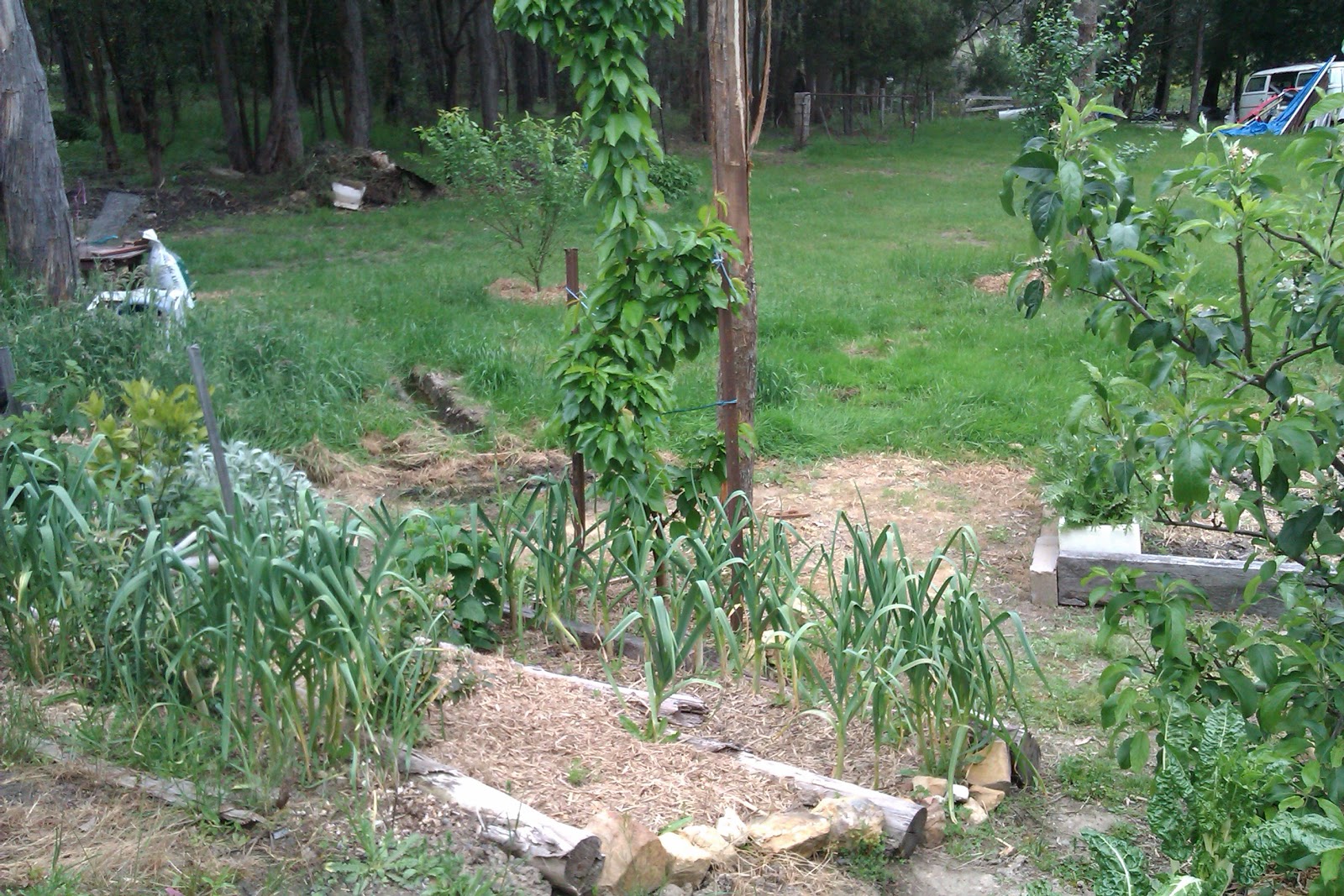
the garlic
I wanted to show you how easy it is to set up a workable vegie patch. As you can see from the photos, we struggle with lack of sun due to the surrounding trees. 
Of course its easy for me living in the bush, as I'm always able to rig together beds using old logs, old bricks, tyres, rocks & anything else I can get my hands on. On the left is the beginnings of what we call "The Marquee", before the netting went up.
At this stage we had a few baby dwarf fruit trees in. I'd also established strawberries on the old horse poo pile.


Above: Early Spring, the garlic was going great guns, looking very healthy.


Some of the garlic after harvest.
spring 2012

apricot tree
Above & Below:  a before & after shot of a bed  I threw together . Lots of good soil, manure, worm poo, plus mulching of sugarcane straw. You will see a vegie foam box of tansy I planted  because a) the flowers attract bees b) tansy is a companion plant for apples. The zucchinis were so good this year that noone was allowed to leave our property without taking at least one mammoth zucc home.


Zucczilla

The raspberries - late summer
the raspberries in spring
Raspberries, cherries & blueberries

Above: I have set up an old sofa bed frame to train the raspberries though, to make it easier to pick when ripe. Unfortunately, this year, I should've been more diligent in pulling out suckers & keeping the big thick new growth. Instead of a well trained vine, I had a bushy mess. I've since brushed up on my berry pruning skills. Never underestimate the value of You Tube for these lessons. There is always some expert who has posted a great training video.


Tub fulla mint


silverbeet & strawberries


Right: a mammoth tomato. Thanks heirloom seeds.


Below: Another hastily thrown together garden bed.  As it's April, I still haven't harvested my pumpkins. Always wait until the plant dies off. They keep better if you do. Once the plants are established, if the vines keep growing - squeeze the tips of new growth off, so the energy goes to the fruit, not to an ever increasing plant.
The Pumpkin Patch
The Pumpkins get going


Above: Ive placed rio over the cucumbers so I can train the vine over. Great idea if you are short of space - train it up a wall. It also keeps the fruit off the ground. Notice the tyres - not pretty but brilliant strawberry pots, or compost bins. I chuck my weeds in them, cover & let them do their thing.

Below:   the various stages of cucumbers. It is April now & they're still producing, much to my  surprise.
Cucumbers trained across the wire
Cucumbers

Allowing fruit to hang down & not rot.
3 beautiful organic apples
baby dwarf apple

a huge apple - only 1 produced on this tree, thanks wind.


Broadbeans popping up.
some of the produce


Above: My young apples produced their 1st decent crop this year. The apples are now stewed & in my freezer. I don't spray them, so we put up with a few munch holes in them but most were superficial, & well worth it for the taste. I tried 2 tricks this year for keeping pests at bay. One was nasturtians & chives planted around the base, to deter the bugs. The theory  with the nasturtians is that they are sacrificial lambs. The bugs will munch on the nasturtians instead of your fruit. And, of course, they are bee attracters.The chives act as a deterrent. I also hung moth balls on all the fruit trees as this is supposed to deter possums, parrots AND pests. This one came from my Dutch Mother-in-law. I'll try anything, so I did it all, with great success.


Planting guide for Autumn: We are in a cold temperate zone. The days are still warm, so now is the time to put in lettuce, silverbeet, beetroot, garlic, leeks, onions, spring onions, cabbage, cauliflower, peas & snow peas - just to name a few. Or, you can rest your beds for next Spring. You could plant a green crop to add nutrients to the soil. It's time to add compost to the soil to prepare for  Spring - dig & turn the soil well.

http://www.abc.net.au/gardening/vegieguide/
http://www.grow-n-eat.com/companion-planting-australia.html


MULCH MULCH MULCH - if planting vegies in Autumn, always mulch well to protect the plants from frost. Make your own igloos out of polypipe & plastic or you can buy them from good nurseries.


Happy Grubbing - if you have any questions, please feel free to post them. 

Tamara


Thursday, 7 March 2013

Lifestyle Block - with Snakes


The little house in the Bush
Sun? What Sun!
It's Autumn now & of course, we are in the midst of a heat wave. You have to love this crazy weather. I don't deal with heat well.  I tend to flop around, whining, like a beached whale. As it's too hot to be out there working, I thought I'd take you through my garden in pictures. As the caption says, we live on 4 acres, close to Melbourne. A dear friend from New Zealand came to visit once & told us "wow, you live on a lifestyle block - with snakes" NZ people don't like snakes. We laughed so hard, we have kept the name.
Another view

Yes, we live in the bush. Amongst the trees. In a "cold" climate, roughly 600 metres above sea level. We get snow. I have had to really think about placement of the herb & vegetable gardens due to the shade created by the trees or the fierce frosts, the occasional snowfall & the wind. The ultimate design has more shade in the afternoon to protect the plants from that scorching summer afternoon sun but it's not always possible. I lament the lack of sun in the Winters. That sun stays so low in the sky, it doesn't get above the trees. We get constant phone calls from companies selling solar panelling. My standard answer now is (& this one made my daughter laugh) "sorry, I live in the bush, we don't get sun here" & hang up. I always wonder what they think.


Side view of waterfall
The Front
Boysenberries on the watertank


Unfortunately, the soil in our area is clay, clay, more clay, & sandstone. I was very fortunate to own horses for many years. I didn't have much time for gardens then, but boy, I had some serious horse poo. All my gardens have been created from piles of horse poo. Thanks girls, you did a great job. I created gardens using logs, sleepers, stone, - anything I could lay my hands on really. The poo sat for a few months, to break down & encourage worm movement. And then the planting began. Become friendly with your local horsey people. They are always keen for people to take off their hands  the enormous piles of horse poo that is collected. Don't ever use it fresh, let it sit for a few months before planting.

My Poo Producers
I have a confession to make. No garden is safe from my secateurs. If I come to visit, I will be taking away cuttings & seedlings. Call it a weakness. My Aunty is embarrassed walking anywhere with me. I even pinched some interesting seed pods from Monkey Park in Launceston this week. I can walk around a lot of my garden & point out where I've pinched most of my plants. My Mum has been a regular source of amazing succulants. My theory is, if it strikes, Im on a winner, if it dies, ah well, I haven't lost much.
I would describe my garden as "cottage" rather than "formal". It is a mixture of natives, succulents, flowers, ground covers. No formal garden here. The good thing about my messy mixes is that every season will bring new flowers, new growth, new colours. This is important to keep those bees coming to your garden. I make sure I plant shade lovers like azaleas in the front of the house where it stays in shade through Winter. The shade loving herbs are placed behind the "big tree' or under larger bushes. Mint, coriander, bergamot, echinacea, marshmallow, fennel are all moisture, shade loving herbs. Coriander bolts to seed if placed in a hot, sunny position. Plant with your nasturtiums to keep them happy.
My passion at the moment is my herb garden. They are so much fun to grow. Fascinating plants, flowers, scents, and by jingo, they're good for you. There is nothing like picking your own herbs for cooking, basil for example. The scent & taste is intoxicating. 


Herb garden
 
The Rotating Vegie Patch


We have many visitors to our garden. I like to keep a certain portion of our acreage "natural" to encourage the natural order of things - ie the native grasses, flowers, birds, insects, reptiles. Luckily our neighbour is like minded so we have created a wonderful sanctuary & corridor for the native animals around a big lake. Unfortunately we have lost many animals on the road out the front (including 2 dogs). I just wish people would slow down in such a sensative area.
The House Herb/Vegie garden

My little Visitors.


Koalas, echidnas, wombats, chocolate wallabies, sugar gliders, possums &  the eastern grey roo all make an appearance. We also have a huge array of birds - crimson rosellas, a magpie dynasty, currawongs, kookaburras, & water fowl. Also the occasional visitors like yellow winged black Cockatoos, Gang Gangs, & once, after the Black Saturday fires, some very confused and hungry King Parrots. The smaller bird varieties are wonderful too, too many to name. I have  discovered that when the birds all shriek & hit the trees, eyeing the sky nervously, there is a Wedge Tailed Eagle overhead. The shriek is something you cant ignore, its quite funny. I always go have a look, & sure enough, an eagle. I witnessed the demise of a duck on the lake. Death by eagle, it was gruesome. The Bush can be cruel. We have our share of the scary ones too - spiders, reptiles & snakes. Im not a huge fan of snakes, since my sis-in-law was bitten by a tiger snake & nearly died. We have had a few brown & copper heads here, but I have a theory on this one too. We have a very big & friendly kookaburra dynasty, that breed here every year. There are never fewer than 5 around. We can be digging in the garden when next thing - whoosh, plop & one is sitting on the ground next to you with a big worm, grub or skink dangling in its mouth. The look they give you is hilarious. No self respecting snake would be caught dead round here.  


2 of my Kookas
The Waterfall
We made a waterfall in the back garden. When we were building the house, the ground was so rocky we struggled to dig the stumps deep enough. The sloping garden bed was a nightmare. Pure rock. Its amazing what horse poo can do to transform a rock bed. We just built it up. But we also had an old bath tub. We wanted a water feature, so in she went. We carted rocks from all over the block & created a waterfall. The pump was fitted, with the pipe hidden under a huge rock up the top. Now 3 gold fish live in the pond, protected by waterlilies that I dug out of the lake. We did have 4 goldfish. I was sitting on the decking one afternoon. I heard a plop in the water, looked in time to see one of my kookaburras with a big goldfish wriggling in its beak. I screamed, it took off with me in hot pursuit screaming "drop it ,you rotten bird" It flew to a branch & proceeded to whack the poor fish on the branch a few times before it gobbled it down whole, with me still shrieking like a banshee underneath. Hence the waterlilies.

A cute Skink
 I love it when friends come to visit & freak out when they come across a spider. The first instinct is to get the whole house sprayed to get rid of the nasty, scary insects. Think hard before you do. If you upset the balance of things in the bush, you could end up with more trouble. Like friends, many years ago, who had 1/2 their house eaten out by termites. We always suspected that regular spraying to kill the insects, especially black ants (the natural enemy of the termite) might have been the problem. The only thing that gets killed here is the white tail spiders, millipedes, slugs & snails. One fun activity is going out in the garden, after a rain, with a bucket of water & vinegar. Its always snail season so I go snail huntin'. I tried just water, but the things have in built snorkels, & they always managed to climb out. The vinegar fixes that problem. I cant squash them, its too nasty. Traps can be made for millipedes by rolling up wet newspaper & leave overnight in your garden. Burn it the next day.  I hate those things - they eat everything. And nothing eats them - they stink, & mustn't be very tasty. There is a slug & snail bait you can buy commercially that kill millipedes. I have had to resort to this method occasionally I'm ashamed to say, but it's epidemic here. Black horrors. Only use bait if you are certain no pet or native animal can get to it, but nothing eats millipedes. 

My Attempt at "Art"
Next Blog will be a walk through my Marquee to see how my vegetable season went. Ive been Most pleased this year with my produce. However, over the years I have worked out what grows well & what doesn't. I concentrate on what does well. This is true for your whole garden. I have lost many diosmas to snow. I always thought they were hardy. Not here apparently. So, no more of that. If certain succulents cannot handle the wet winters & rot, I either try to place in a sunnier position, or give up. I have never had a brilliant tomato production. Our Winters finish too late, the season never long enough. I have solved that problem by having seedlings started in my bro-in-laws hothouse. Thanks Pete, my tomatoes are brilliant this year. The garden is a changing, morphing entity - every season is different. Thats why its so much fun.

Happy Grubbing
Tam.